what to post when building in public: a founder's guide
not sure what to share when building in public? here are 7 types of posts that actually work for founders, plus tips to stay consistent without burning out.
You’ve heard the advice a hundred times: build in public. Share your journey. Post about what you’re working on.
Great. But what do you actually post?
This is where most founders get stuck. You open Twitter or LinkedIn, stare at the blank text box, and realize you have no idea what’s worth sharing. Your last commit? Your MRR? The bug you spent four hours on? It all feels either too boring or too personal.
The truth is, building in public isn’t about sharing everything. It’s about sharing the right things in a way that makes people care. Here’s what actually works.
What Is Building in Public and Why Does It Matter
Building in public means sharing your product journey openly — the wins, the losses, the decisions, and the lessons — as you build. It’s not a changelog. It’s not a marketing campaign. It’s an ongoing conversation with your audience about what you’re creating and why.
Why does it matter? Because trust compounds. According to the Edelman Trust Barometer, people trust individuals far more than they trust companies. When you share your real journey as a founder, you’re building a relationship with potential customers, investors, and collaborators before you ever ask them for anything.
Founders who build in public consistently report faster audience growth, stronger early adoption, and more meaningful connections than those who stay quiet until launch day.
But the keyword is “consistently.” And consistency requires knowing what to post.
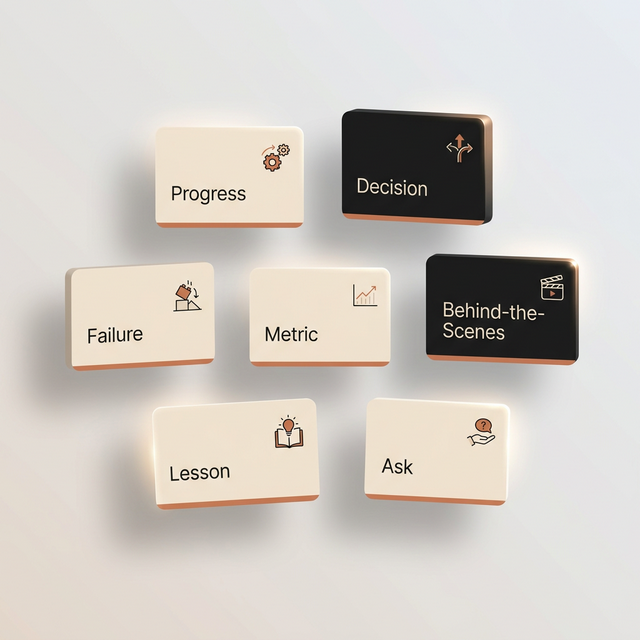
7 Types of Posts That Work for Build-in-Public Founders
Not every post needs to be a breakthrough insight. Here are seven categories that consistently perform well, with examples you can adapt.
1. The Weekly Progress Update
The simplest format and the backbone of any build-in-public practice. Share what you shipped, what you learned, and what’s next.
“This week: rebuilt our onboarding flow from scratch. Old flow had a 40% drop-off at step 3. New flow cuts it to two steps. Shipping Monday.”
2. The Decision Post
Every week you make decisions — what to build, what to skip, which tool to use, how to price something. These are gold. People love seeing how other founders think.
“We had to choose between adding a free tier or keeping paid-only. Here’s why we went with a generous free plan and what we’re betting on.”
3. The Failure or Mistake Post
This is the format that builds the most trust. Sharing what went wrong — and what you learned — makes you relatable and credible.
“I spent two weeks building a feature based on one customer’s request. Nobody else wanted it. Lesson: wait until you hear the same request three times before building.”
4. The Metric Share
Numbers tell stories. Share revenue milestones, user counts, conversion rates, or churn data. Add context about what drove the numbers.
“Hit 500 users this week. But here’s the thing — 80% came from one Reddit post, not from the 30 tweets I wrote. Distribution is lumpy.”
5. The Behind-the-Scenes Post
Show work in progress. Screenshots of your dashboard, your Figma file, your code editor. Let people see the messy reality behind the polished product.
6. The Lesson or Tip Post
Extract a generalizable insight from your specific experience. These are highly shareable because they’re useful to other founders too.
“After 6 months of building, the single most impactful thing I did was talk to users every week. Not surveys. Actual 15-minute calls. Everything changed after that.”
7. The Ask Post
Ask your audience for input. What feature should you build next? What name sounds better? How do they handle a specific problem? This drives engagement and makes people feel invested in your journey.
Mix these formats throughout your week and you’ll never run out of things to post.
How to Turn Your Weekly Progress into Social Content
The biggest misconception about building in public is that it takes extra time. It doesn’t — if you have the right system.
Your workweek is already full of content. You just need to capture it.
Keep a “content log” running. Use a simple note (Notion, Apple Notes, whatever) and jot down one line every time something interesting happens during your day. A customer said something surprising. You made a tradeoff. You hit a wall. You shipped something. One line. That’s it.
At the end of the week, scan your log. Pick two or three items that would make good posts. Write them in 10-15 minutes total.
Follow the “so what” test. For every item in your log, ask: “Why would someone who doesn’t know me care about this?” If you can answer that question, it’s a post. If you can’t, skip it.
Here’s the pattern that works: specific event + context + takeaway. “We doubled our conversion rate” is boring. “We changed one word on our landing page headline and doubled conversions — here’s the word and why it worked” is a post people will save and share.
If you’re using tools like Ravah that already know your product context, this gets even faster. Instead of rewriting your product story from scratch every time, you start from a tool that already understands what you’re building and who you’re building it for.
Where to Post Your Build-in-Public Updates
Not every platform is equal for building in public. Here’s where to focus:
Twitter/X is still the home base for the build-in-public community. Short-form, real-time, great for daily updates. The #buildinpublic hashtag is active and supportive. Start here if you’re picking one platform.
LinkedIn is where B2B founders get the most business impact. Longer posts, professional audience, great for detailed lessons and decision posts. Founder posts get far more reach than company pages. We wrote a full guide on how to write about your startup on LinkedIn.
Indie Hackers is a smaller but highly engaged community. Great for longer updates, milestone posts, and getting feedback from other founders.
Reddit has massive reach but requires a different approach. Lead with value, not self-promotion. Subreddits like r/SaaS, r/startups, and r/indiehackers are good starting points.
Your blog is your owned platform. Longer content lives here, and it builds SEO value over time. Cross-post highlights to social.
You don’t need to be on all of these. Pick two: one for short daily posts (X or LinkedIn) and one for longer weekly updates (blog, Indie Hackers, or LinkedIn articles).
Tips for Staying Consistent Without Burning Out
The number one reason founders stop building in public isn’t lack of ideas. It’s burnout. Here’s how to avoid it.
Set a minimum, not a maximum. Two posts per week is enough. Don’t aim for daily if it’s going to make you resent the whole practice.
Batch your writing. Write two or three posts in one 30-minute session. Don’t try to write a post every day from scratch.
Repurpose aggressively. A weekly progress update can become three tweets, one LinkedIn post, and an Indie Hackers update. Same content, different formats.
Lower your quality bar. Not every post needs to be a polished essay. A two-sentence update about what you shipped today is perfectly fine. The founders who grow fastest are the ones who post regularly, not the ones who post perfectly.
Use tools that reduce friction. The reason posting feels hard is the gap between “I did something” and “here’s a post about it.” The less effort it takes to bridge that gap, the more consistent you’ll be. If you’re using generic AI tools that don’t know your product, you’re adding friction instead of removing it.
Start Posting About What You’re Building
Building in public works. But only if you actually do it.
You don’t need a content strategy. You don’t need a social media manager. You don’t need to be a great writer. You just need to share what you’re doing, what you’re learning, and what you’re building — consistently.
Start with one post this week. Pick any format from the list above. Write it in five minutes. Hit publish.
If you want help turning your product progress into posts that sound like you, get started with Ravah. It knows your product, understands your voice, and generates a week of content from what you’re actually shipping.
Related reading: How to Build in Public as a Solo Founder, Build-in-Public Metrics Worth Sharing, Real-World Building in Public Examples, What Is Building in Public?, Ravah for Indie Hackers
frequently asked questions
- What should I post when building in public?
- There are seven types of posts that work well: weekly progress updates, decision posts, failure or mistake posts, metric shares, behind-the-scenes content, lesson or tip posts, and ask posts. Mix these formats throughout your week and you will never run out of things to share.
- How do I build in public without it taking too much time?
- Keep a running content log during your workweek, jotting one line whenever something interesting happens. At the end of the week, pick two or three items and write them up in 10-15 minutes. Batch your writing and repurpose one update across multiple platforms.
- Where is the best place to build in public?
- Twitter/X is the home base for the build-in-public community and great for daily updates. LinkedIn provides the most business impact for B2B founders. Pick two platforms: one for short daily posts and one for longer weekly updates like a blog or Indie Hackers.
- How often should I post when building in public?
- Two posts per week is a good minimum. Consistency matters far more than volume. Founders who grow fastest are the ones who post regularly, not the ones who post perfectly. Set a minimum rather than a maximum to avoid burnout.
ready to turn your ideas into content?
stop the grind and start growing. ravah turns your building-in-public moments into content that attracts customers — in minutes, not hours.