how to write about your startup on linkedin without sounding like everyone else
founder-led linkedin content outperforms company pages. here is how to write posts about your startup that sound like you, not a press release.
You know you should be posting on LinkedIn. Your investors are there. Your customers are there. Other founders in your space are there, racking up impressions while you stare at a blank text box wondering what to say.
The problem isn’t LinkedIn. The problem is that most startup founders default to writing like a press release instead of writing like a person. And in a feed full of corporate announcements and AI-generated fluff, sounding human is the single biggest advantage you have.
Here’s how to write about your startup on LinkedIn without sounding like everyone else.
Why Founder-Led LinkedIn Content Outperforms Company Pages
Before you spend another minute debating whether to post from your personal profile or your company page, here’s the reality: founder posts get 5-10x more reach than company page posts.
LinkedIn’s algorithm favors people over brands. When you post from your personal profile, you’re not just a logo. You’re a person with a story, and that’s what gets engagement.
Company pages are fine for job postings and press releases. But if you’re trying to build awareness, trust, and pipeline for your startup, your personal profile is the channel that matters.
This is especially true for early-stage founders. You don’t have a marketing team. You don’t have brand recognition. What you do have is a unique perspective on the problem you’re solving, and that’s more interesting than any company announcement.
How to Find Your Authentic Voice on LinkedIn
The biggest mistake founders make on LinkedIn is trying to sound “professional.” They strip out personality, hedge every statement, and end up writing posts that could’ve come from any company in their space.
Your voice is already there. You just need to stop filtering it out.
Write like you talk. If you wouldn’t say “I’m thrilled to announce” in a conversation, don’t write it in a post. If you’d tell a friend “we finally fixed that annoying bug that’s been driving me crazy for two weeks,” write that instead.
Pick a lane. You can’t be everything. Are you the technical founder who explains complex things simply? The first-time founder sharing raw lessons? The industry veteran calling out what’s broken? Pick an angle and stick with it.
Read your drafts out loud. If it sounds like a press release when you say it, rewrite it. Your content should sound like you’re explaining something to a smart friend over coffee.
Drop the hedge words. “I think,” “arguably,” “potentially,” “it could be said that” — cut all of it. Take a position. Say what you mean. People follow founders who have opinions, not founders who hedge everything.
If you’ve been relying on generic AI tools that strip out your personality, you’re actively making this harder. That’s exactly what happens when you use tools without brand context.
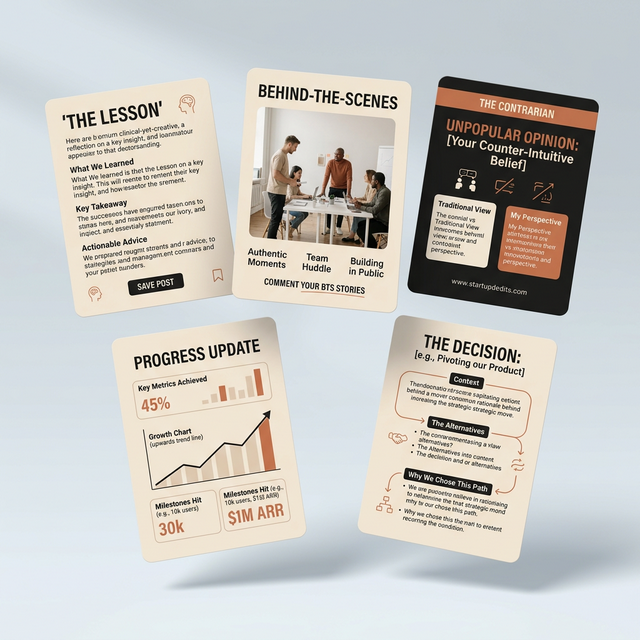
5 LinkedIn Post Templates for Startup Founders
You don’t need to reinvent the wheel every time you post. Here are five formats that consistently work for founders.
Template 1: The Lesson Post
I made a mistake with [specific thing].

Here's what happened: [2-3 sentences about the situation]

What I learned: [the actual takeaway]

If you're facing the same thing, here's what I'd do differently: [actionable advice]
Example: “I spent three weeks building a feature nobody asked for. Our biggest customer had mentioned it once in passing, and I took it as a mandate. When we shipped it, zero people used it. Now I don’t build anything until three separate customers ask for the same thing unprompted.”
Template 2: The Behind-the-Scenes Post
Most people see [the polished result].

Here's what actually happened behind the scenes: [the messy reality]

[Specific details, numbers, timeline]

The takeaway: [what this means for your audience]
Example: “Most people saw our Product Hunt launch day. What they didn’t see was the three failed launches before it, the landing page we rewrote eleven times, and the 4 AM panic when our demo broke. We got 400 upvotes. But the real win was the 23 DMs from founders who said ‘I needed this.’”
Template 3: The Contrarian Take
Unpopular opinion: [your actual belief]

Here's why: [your reasoning with specific evidence]

What I do instead: [your alternative approach]
Example: “Unpopular opinion: most startup content calendars are a waste of time. Planning 30 days of posts in advance means you’re writing about things that haven’t happened yet. I post about what I shipped this week, what I learned yesterday, what’s actually on my mind. Real-time beats pre-planned every time.”
Template 4: The Progress Update
[Time period] update on [your product]:

What we shipped: [specific features or milestones]
What surprised us: [unexpected learning]
What's next: [where you're headed]

[One honest reflection about the journey]
Template 5: The How-We-Decided Post
We had to choose between [option A] and [option B].

Here's what we considered: [the actual tradeoffs]

We went with [your choice] because [real reasoning]

[What happened as a result]
These formats work because they’re specific, honest, and give readers something useful. For more ideas on what to share, check out our guide on what to post when building in public.
What to Avoid: Generic Content That Kills Engagement
Some posts are engagement killers. Here’s what to cut:
The “thrilled to announce” post. Nobody is thrilled. You’re excited, nervous, proud, or terrified. Use a real emotion.
The jargon dump. If your post includes “synergy,” “disrupting,” “best-in-class,” or “end-to-end solution,” rewrite it. These words signal that you have nothing specific to say.
The humble brag. “I can’t believe we hit 10K users. We’re just a small team of two.” This format has been done to death. Instead, share the actual story of how you got there.
The AI-generated post. You know the ones. Perfect grammar, zero personality, reads like it was written by a committee. If you’re using AI to write your posts, make sure the tool actually knows your product and voice. Otherwise you’re just adding to the noise. We wrote a whole piece on why generic AI content is killing your brand.
The wall of hashtags. Three to five relevant hashtags is plenty. A post ending with fifteen hashtags screams “I don’t know what I’m doing.”
How to Stay Consistent with LinkedIn Posting
Consistency beats virality. One post per week, every week, beats five posts one week and silence for a month.
Batch your content. Spend 30 minutes on Monday morning writing two or three posts for the week. Don’t try to write in the moment.
Post about what you’re already doing. You shipped a feature? That’s a post. You had a hard customer call? That’s a post. You made a decision between two approaches? That’s a post. The content is already in your workday. You just need to capture it.
Keep a running note. Throughout your week, jot down moments that felt interesting, frustrating, or surprising. These are your content seeds. When it’s time to write, you’re not starting from zero.
Lower your bar. Not every post needs to be a masterpiece. A short, honest update about what you’re working on this week is better than no post at all. The founders who grow fastest on LinkedIn are the ones who post regularly, not the ones who post perfectly.
Use tools that know your product. The reason most founders fall off posting isn’t laziness — it’s the friction of translating what you’re doing into a post. If your content tool understands your product, your progress, and your voice, that friction drops dramatically.
Start Writing Posts That Sound Like You
LinkedIn is the single best platform for startup founders to build trust, attract customers, and connect with investors. But only if you sound like yourself.
Stop writing like a press release. Stop hedging every take. Stop copying what “LinkedIn influencers” do.
Write about what you’re building, what you’re learning, and what you actually think. That’s it. That’s the strategy.
If you want help turning your product updates into LinkedIn-ready posts that actually sound like you, get started with Ravah. It knows your product, learns your voice, and generates content you’d actually want to post.
Related reading: The Best LinkedIn Hooks for Founders, LinkedIn Carousels for Founders, LinkedIn Post Ideas for Founders, Technical Founder LinkedIn Brand, What Is Personal Branding?
frequently asked questions
- Should I post from my personal LinkedIn profile or my company page?
- Post from your personal profile. Founder posts get 5 to 10x more reach than company page posts because LinkedIn's algorithm favors people over brands. Your personal perspective is more engaging than a company announcement.
- How often should startup founders post on LinkedIn?
- Aim for at least one post per week, every week. Consistency beats virality. Batch two to three posts on Monday morning and schedule them throughout the week so you never start from a blank page.
- What types of LinkedIn posts work best for founders?
- Five proven formats are lesson posts, behind-the-scenes posts, contrarian takes, progress updates, and how-we-decided posts. They work because they are specific, honest, and give readers something useful.
- How do I avoid sounding like everyone else on LinkedIn?
- Write like you talk, drop hedge words, take clear positions, and read your drafts out loud. If it sounds like a press release, rewrite it. Avoid phrases like 'thrilled to announce' and jargon like 'synergy' or 'best-in-class.'
ready to turn your ideas into content?
stop the grind and start growing. ravah turns your building-in-public moments into content that attracts customers — in minutes, not hours.